
The Scent of Excellence — Bourbon Vanilla from Madagascar, selected at the source
Few agricultural commodities see price swings as pronounced as vanilla: the same kilo of Bourbon pods from Madagascar has, over the past fifteen years, been multiplied tenfold and then returned to its starting level within the space of a few harvests. For an uninitiated buyer, these swings can seem incomprehensible, even suspicious. In reality, they follow a precise market logic, largely determined by the geography of global production. Understanding this logic makes it possible to correctly interpret a price, whether high or abnormally low, rather than simply enduring it without any reference point.
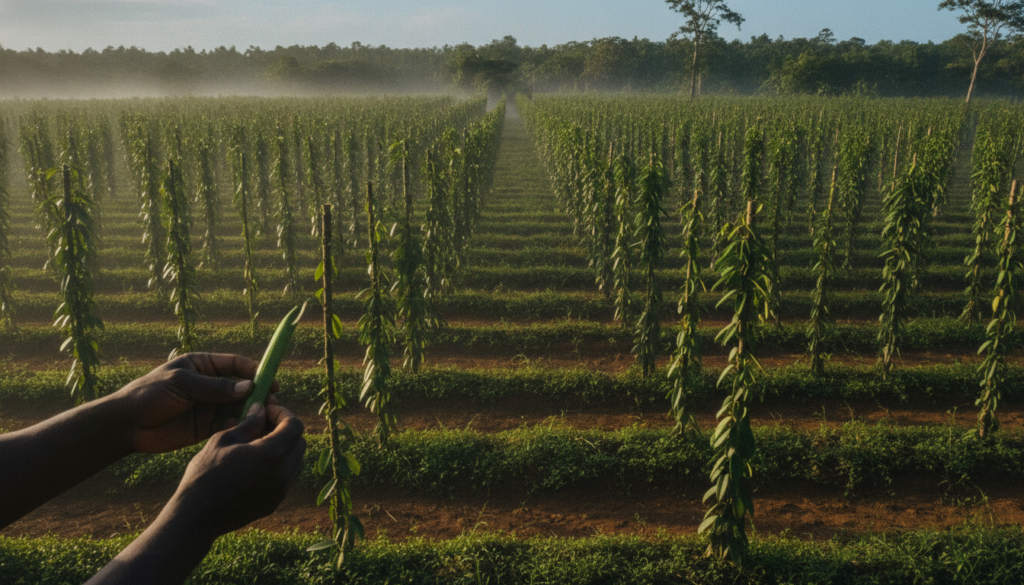
The first key to understanding lies in the geographic concentration of production: Madagascar accounts, in most years, for between 70 and 80% of global vanilla supply, a share itself largely concentrated in the SAVA region in the north-east of the country. This concentration means that a supposedly global market in fact depends, for the most part, on the production conditions of a single, relatively small geographic area. A more geographically diversified market would absorb a localised shock with little consequence for global prices; the vanilla market, by contrast, passes on almost mechanically any shock occurring in northern Madagascar to world prices.
The SAVA region is directly exposed to Indian Ocean cyclones. A tropical system crossing the growing areas at the wrong moment can destroy a significant part of a harvest, with an effect multiplied by the production delay already mentioned: a damaged plantation will not produce pods again for several seasons, extending the impact of the shock well beyond the year of the event itself.
The vanilla market alternates between phases of shortage, which drive prices up, and phases of overproduction, which cause them to collapse sharply once several abundant harvests accumulate without demand fully absorbing the available stocks. This is precisely the situation observed in 2026: overproduction combined with still-high stocks among buyers has caused prices to collapse compared with the peaks reached during previous crises.
For several years, the Malagasy authorities attempted to maintain a regulated floor price, around USD 250 per kilo, via the Conseil National de la Vanille (CNV, National Vanilla Council). The dissolution of this body and the abandonment of this imposed price allowed the market to adjust more freely to actual supply and demand — a healthy adjustment in the medium term, but one that translated into significant short-term jolts for producers and buyers alike.
Beyond macroeconomic factors, the price of a specific batch also depends on its preparation quality and grade — a whole, unsplit pod selected for its aromatic intensity (Gourmet grade) is structurally more expensive than a pod destined for industrial extraction, regardless of overall market fluctuations.
Over the past decade, the vanilla market has been through several marked cycles: a spectacular surge driven by a combination of climate-related shortage and speculation, followed by a gradual rebalancing as newly planted areas came into production. In 2026, the market is in a correction phase after several abundant harvests, with prices markedly below the historic peaks reached a few years earlier. This alternation is not an accident: it is the structural signature of a market where supply takes more than a year to respond to a price signal, which mechanically favours cycles of over- then under-production rather than a stable equilibrium.
| Cycle phase | Typical trigger | Effect on prices | What it changes for a buyer |
|---|---|---|---|
| Supply shock (cyclone, poor harvest) | Climate event localised in the production area | Sharp, rapid rise | Documented, already secured batches gain value; one-off purchases become more uncertain |
| Post-shock speculation | Intermediaries anticipating a prolonged shortage | Continued rise beyond the initial shock | Heightened vigilance over the consistency between the announced price and the batch’s actual quality |
| New plantings | Producers responding to high prices (effect delayed by several years) | Stabilisation then gradual reversal | Prices gradually become more legible and predictable again |
| Overproduction | Accumulation of several abundant harvests | Correction, sometimes sharp, downward | A real opportunity, provided the price drop is not accompanied by a drop in quality or traceability |
This lag between the price signal and the supply response — never immediate, always delayed by several seasons — alone explains much of the amplitude of the cycles observed on this market, far more than any simple short-term speculative logic.
A price well above the recent average generally signals a genuine strain on supply (climate shock, low stocks) rather than a simple commercial decision — in this context, a high price that is consistent with the market is not in itself a warning sign. Conversely, an abnormally low price on a vanilla presented as Gourmet-grade Bourbon from Madagascar deserves questioning rather than reassurance: either the seller is passing on a genuine market decline (which does happen, as in 2026), or the price conceals a compromise on quality, actual origin, or batch documentation — the criteria already detailed in our guide to recognising genuine Bourbon vanilla from Madagascar remain the best way to settle between these two hypotheses.
For home use, global market volatility has a limited impact on the actual budget: the quantities bought remain modest, and a batch’s preparation quality matters more, for the final experience, than the exact level of world prices at the time of purchase. The most useful reference therefore remains the consistency between the displayed price, the announced grade (Gourmet, whole pods) and the batch’s documentation — rather than chasing a rock-bottom price that does not always reflect a genuine opportunity.
For a chef, an artisan or a manufacturer building an offering around vanilla over the long term, volatility changes the nature of the problem: it is no longer just a one-off price, but the ability to secure a constant supply, at stable quality, despite market cycles. This is precisely where the difference lies between a simple spot purchase, fully exposed to market jolts, and a supply relationship built with a partner capable of anticipating tensions rather than passing them on abruptly to their customers. Supply consistency, quality stability from one batch to the next, and transparency on origin then become criteria at least as decisive as the price displayed at any given moment.
A combination of climate shocks in the Malagasy production areas and a marked imbalance between reduced supply and sustained global demand drove prices to exceptionally high levels during previous crises.
Several abundant harvest seasons created a situation of overproduction, worsened by still-significant stocks among buyers and by the end of a regulated floor-price system in Madagascar — two factors that accelerated the downward adjustment.
Not necessarily, and never at the expense of checking the batch’s quality and documentation. A price consistent with a genuinely declining market is one thing; a price abnormally low relative to the market and the announced grade is another, and deserves to be questioned rather than seized without verification.
No serious content can predict with certainty the future evolution of a market so dependent on unpredictable climate factors. What does remain predictable, however, is the market’s structure itself: strong geographic concentration and a long production cycle will continue to produce marked swings, in either direction.
Yes, indirectly but genuinely: a persistently too-low price discourages investment in rigorous preparation (full curing time, careful sorting), while a market that fairly rewards quality encourages producers to maintain high standards rather than shorten their preparation cycles.
By diversifying sources where possible, by working with a partner able to document and secure volumes over time rather than deal by deal, and by avoiding dependence on a single one-off purchase to cover production planned over several months.
Discover our selection of Bourbon vanilla pods from Madagascar, traceable batch by batch.