The Scent of Excellence — Bourbon Vanilla from Madagascar, selected at the source
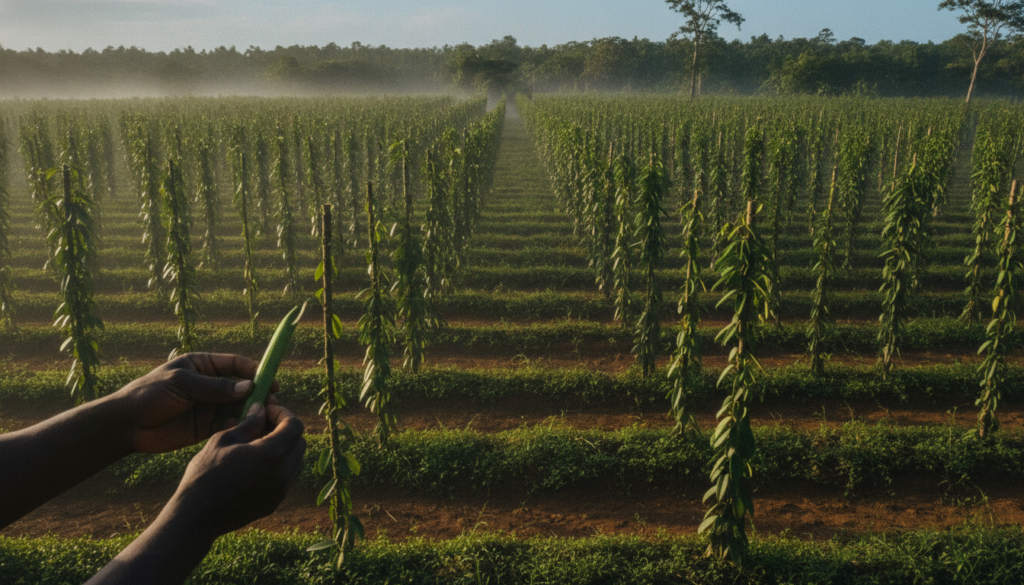
A vanilla pod that arrives at a pastry chef’s, a manufacturer’s or an individual’s home has, by that point, already lived more than a year. Between the flower opening on the vine and the black, supple, fragrant pod opened in a kitchen, a long, precise process unfolds — one that remains largely manual to this day. Understanding this process is not just a matter of curiosity: it is understanding why quality vanilla has a real production cost, and why certain shortcuts always come at the expense of aromatic quality.
The vanilla orchid (Vanilla planifolia) produces a flower that opens for a single morning, closes that same day if it has not been fertilised, and will never reopen. In Madagascar, as in almost all production regions worldwide, the vanilla’s natural pollinating insect (a specific bee native to Mexico) is absent. Pollination must therefore be carried out by hand, flower by flower, by a grower who walks through the plants every morning throughout the flowering period so as not to miss a single open flower. This gesture, repeated thousands of times across a farm, single-handedly determines the entire coming harvest: a flower not pollinated in time will never produce a pod.
Once harvested at maturity — a judgement call that itself requires experience, since a pod picked too early or too late loses potential aromatic quality — the green pod, odourless and inedible as it is, begins a four-step transformation process known as the Bourbon method.
Freshly harvested pods are plunged into water heated to around 65 °C for a few minutes. This thermal shock abruptly halts the pod’s natural ripening process and triggers the first enzymatic reactions responsible for aroma development. Water that is too hot, or an immersion time that is not properly controlled, can “cook” the pod and irreversibly compromise its quality — this is a technically simple step, but one that leaves no room for error.
Immediately after scalding, the pods are wrapped and stacked in padded boxes, protected from any heat loss, for 24 to 72 hours. This phase, during which the pod literally “sweats”, is when the enzymes released by the thermal shock truly begin turning the green pod into a brown one, developing the first aromatic compounds. A poorly insulated sweating box or an insufficient duration produces a pod with uneven colour and an incomplete aroma.
The pods are then exposed to the sun for a few hours each day, then brought back under cover to avoid drying out too quickly, in a cycle repeated over several weeks. This phase then continues in the shade, to refine colour and texture, until reaching a target moisture content of around 40%. Depending on the season’s weather conditions, this step lasts two to six weeks — the phase most dependent on climate, and the one that explains why a poor season can affect the quality of an entire harvest, beyond volume alone.
The dried pods are finally stored in wooden trunks lined with wax paper, away from air and light, for a period ranging from three months to a year depending on the preparation standards applied. It is during this period, the longest of the whole process, that the pod develops its finest aromatic complexity — the one that sets a properly cured vanilla apart from a vanilla dried too quickly to meet urgent demand.
In total, from the flower’s pollination to a pod ready for sale, it takes around twelve to fourteen months.
| Step | Approximate duration | What it achieves | Risk if poorly controlled |
|---|---|---|---|
| Scalding | A few minutes | Stops ripening, triggers the first enzymatic reactions | “Cooked” pod, flat aroma |
| Sweating | 24 to 72 hours | Transforms the colour, releases the first aromas | Uneven colour, incomplete aroma |
| Drying | 2 to 6 weeks | Reduces moisture to around 40%, develops suppleness | Brittle pod, or conversely poorly dried |
| Curing | 3 months to 1 year | Builds the final aromatic complexity | Aroma correct but shallow, weak length on the palate |
Each of the four steps leaves an identifiable mark on the final pod, for anyone who knows how to read it. Poorly controlled scalding gives a pod a flat smell, sometimes slightly “cooked”. Insufficient sweating shows up as an uneven colour, leaning towards green rather than the expected deep brown. Drying that is too fast, often driven by a wish to bring a harvest to market sooner, produces a brittle pod, lacking the characteristic suppleness of well-prepared vanilla. A shortened curing period, finally, gives a pod whose smell is fine when the pack is opened, but without the depth and length on the palate of a vanilla cured over several months. This is precisely why preparing vanilla remains, even today, a craft in its own right rather than a simple process that can be automated industrially — human judgement comes into play at every step.
This long cycle has a direct consequence on how the vanilla market works. Unlike a raw material whose production can adjust quickly to demand, the supply of Bourbon vanilla responds to any change in planting with a delay of more than a year — a farm cannot “produce more” quality pods within a few weeks to meet a spike in demand. This is one of the structural reasons behind the price volatility observed on the global vanilla market, in addition to the climate factors already mentioned. Understanding this timeline helps explain why a professional buyer, in particular, benefits from securing supply over the long term rather than thinking only in terms of one-off purchases.
Once curing is complete, each pod is individually sorted according to its length, integrity, suppleness and aromatic intensity. This sorting determines the pod’s final grade — rigorous preparation at every previous step is the necessary condition for a pod to qualify for the most sought-after grade, reserved for whole, unsplit pods selected for their aromatic intensity. Less careful preparation, even on a pod of identical origin, naturally steers production towards extraction uses rather than sale as a whole pod. A pod’s grade is therefore never a simple sales argument: it is a direct reflection of the rigour applied at each of the four steps described above.
Because the vanilla orchid’s natural pollinating insect is not present in production regions such as Madagascar. Without human intervention, the flower — which opens for only one morning — would never be fertilised.
A shortened preparation cycle (accelerated drying, curtailed curing) reduces production time and therefore cost, but generally degrades the final aromatic quality — a signal to take into account rather than ignore when faced with an abnormally low price.
The Bourbon method (scalding, sweating, drying, curing) is specific to Madagascar, Réunion Island and the Comoros. Other origins, such as Tahiti or Mexico, apply different preparation methods, suited to their own botanical variety.
Each successfully pollinated flower produces a single pod. This is why the act of hand pollination, repeated flower by flower, is so decisive for the final volume of the harvest.
Technically, yes — for example with heated-chamber drying rather than sun drying. But this acceleration almost always results in a loss of aromatic complexity compared with a traditional cycle carried through to completion, which explains why the most recognised preparation methods remain, even today, the slowest ones.
Both. Unstable weather during flowering affects the volume of pods available at harvest; unstable weather during the sun-drying phase directly complicates that step, which depends on a controlled alternation of exposure and shelter.
Discover our selection of Bourbon vanilla pods from Madagascar, traceable batch by batch.