
The Scent of Excellence — Bourbon Vanilla from Madagascar, selected at the source
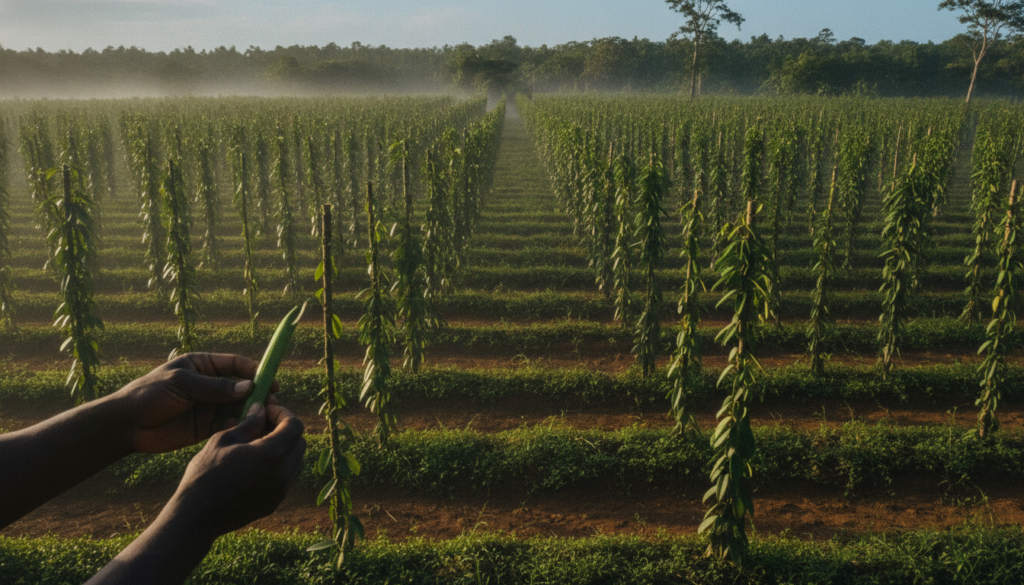
Not all vanillas are equal, and not all vanillas taste alike. Behind a single word — “vanilla” — lie different botanical species, distinct preparation methods and aromatic profiles that can be worlds apart. A dessert flavoured with Tahitian vanilla and the same dessert flavoured with Madagascar vanilla will not deliver the same experience, even though both products honestly carry the word “vanilla” on their label. Understanding these differences makes it possible to choose an origin genuinely suited to your use, rather than relying on a general reputation or the first pod that comes to hand. This guide compares the world’s main origins and offers a decision framework depending on whether you are cooking for yourself, for your customers, or for an industrial production.
The term “Bourbon” does not designate a geographic origin in itself, but a preparation method — harvesting at maturity, scalding, sweating, slow drying, curing — historically developed on Réunion Island (formerly Île Bourbon), then extended to Madagascar and the Comoros. Any Madagascar vanilla prepared according to this method is a Bourbon vanilla; but not all Bourbon vanilla necessarily comes from Madagascar, and conversely, the Bourbon method alone guarantees nothing about the exact geographic origin of a given pod. Madagascar nonetheless remains by far the most produced and most recognised Bourbon origin, with a dominant share of global vanilla production.
Bourbon vanilla from Madagascar is renowned for a round, rich profile, with notes of milk chocolate, dried fruit and wood, and strong versatility — it pairs as well with classic sweet preparations as with more elaborate creations. It is the reference point against which most other origins are compared.
Botanically different from Madagascar vanilla (a distinct species, Vanilla tahitensis, rather than Vanilla planifolia), Tahitian vanilla stands out for its floral, fruity, slightly aniseed profile, and for a notable physical feature: it is the only major origin whose pod does not split at maturity. It is highly sought after in fine pastry and ice cream making for its exotic touch, but pairs less naturally with preparations that call for the classic roundness of a Bourbon vanilla.
Ugandan vanilla displays a more intense, bolder profile than Madagascar’s, with availability that has increased in recent years as production has developed. It is a relevant alternative when aromatic intensity matters more than subtlety, particularly for certain industrial formulations.
The original birthplace of vanilla (it was from Mexico that the plant first spread around the world), Mexican vanilla is today produced in limited volumes, with a spicy profile and a slightly woody note. Its relative rarity makes it a more niche origin on the European market.
The world’s second-largest producer behind Madagascar, Indonesia supplies vanilla with a smokier, less refined profile, but with substantial volumes and an often more accessible price structure — a positioning that suits industrial formulation needs more than direct tasting.
| Origin | Dominant aromatic profile | Split pod? | Global availability | Best suited use |
|---|---|---|---|---|
| Madagascar (Bourbon) | Round, milk chocolate, wood, dried fruit | Yes | Very wide — dominant origin | Versatile use, for individuals and professionals alike |
| Tahiti (V. tahitensis) | Floral, fruity, slightly aniseed | No | Limited | Fine pastry, signature creations |
| Uganda | Powerful, bold | Yes | Growing, developing | Formulations where intensity matters most |
| Mexico | Spicy, slightly woody | Yes | Low, niche | Niche, historic use |
| Indonesia | Smoky, less refined | Yes | Substantial | Industrial formulation at volume |
This table is no substitute for a side-by-side tasting — the exact profile also varies by batch, harvest and preparation — but it gives a first reliable benchmark to guide a choice according to the intended use.
Madagascar supplies, in most years, between 70 and 80% of global vanilla supply, a concentration almost entirely carried by the SAVA region in the north-east of the country (Sambava, Antalaha, Vohémar, Andapa — the four districts that give the region its name). This dominance stems from the combination of a terroir historically suited to growing Vanilla planifolia, preparation know-how passed down over several generations of producers, and a supply chain structured around this crop for over a century.
This geographic concentration does, however, carry a direct downside for any buyer, individual or professional: a localised climate shock in northern Madagascar — a cyclone, in particular, as the region is directly exposed to Indian Ocean tropical systems — can affect a significant share of global supply within the same year. This is one of the main reasons for the price volatility observed in this market from one year to the next, a subject detailed in our dedicated article on vanilla price variations. For a professional buyer in particular, this means that a partner able to document and secure supply over the long term becomes a criterion at least as important as the aromatic profile itself.
For personal use, in direct tasting. Bourbon vanilla from Madagascar remains the most versatile choice for classic home use (pastry, creams, infusions) — its round, balanced profile suits the vast majority of recipes without requiring any particular adjustment.
For a chef or an artisan pastry maker. The choice depends on the effect sought — Madagascar for a classic, reliable signature from one recipe to the next, Tahiti for a distinctive floral note on a specific creation, Uganda when a more pronounced intensity is needed in a preparation that must stand out despite cooking or association with other strong flavours.
For an industrial buyer (beverages, food supplements, perfumery-cosmetics). Beyond the aromatic profile alone, three criteria become decisive — consistency of profile from one batch to the next, availability in sufficient volume to secure production planned over several months, and complete batch-level traceability documentation (certificate of origin, phytosanitary certificate) — essential for any origin statement on a final label. An origin with a slightly less spectacular profile but perfectly documented and consistently available can therefore be preferable, in an industrial context, to a rarer but irregular origin.
As detailed in our guide to recognising genuine Bourbon vanilla from Madagascar, no sensory criterion — however well mastered — constitutes in itself legal proof of geographic origin. A well-prepared vanilla can evoke a “Madagascar-like” profile without actually coming from there, just as a genuinely Malagasy but poorly prepared vanilla can disappoint a taster expecting a round, classic profile. Only official batch-level documentation (certificate of origin issued under the Generalised System of Preferences, phytosanitary certificate, traceable batch number) makes it possible to verify a stated origin — a principle that applies to every origin discussed in this article, not just Madagascar.
This documentary requirement becomes fully meaningful as soon as a purchase goes beyond a one-off tasting — a professional building a range around a specific origin, or needing to justify an origin claim on their own labelling, cannot settle for a commercial promise. It is the same principle that applies at Vanilha Noire, where every batch put up for sale remains tied to its origin documentation — whatever the geographic origin concerned.
No: “Bourbon” designates a preparation method historically associated with Madagascar, Réunion Island and the Comoros. Only official origin documentation makes it possible to verify the actual country of production of a given batch.
It is produced in smaller volumes than Madagascar vanilla and answers specific demand in fine pastry, which generally places it in a higher price segment.
Yes, it is even common practice in professional formulation to achieve a specific aromatic profile, provided each origin used remains properly documented and identified.
No: quality depends on preparation and batch selection, not solely on the reputation of the origin. A well-prepared Ugandan vanilla can be of excellent quality, with a profile that differs from Madagascar’s rather than being inferior to it.
Beyond the aromatic profile alone, Madagascar benefits from a long-established, structured supply chain, a production volume sufficient to reliably supply both BtoC and BtoB markets, and a well-established certification ecosystem (origin, phytosanitary) — a combination of factors that reassures as much as it seduces.
Discover our selection of Bourbon vanilla pods from Madagascar, traceable batch by batch.