
The Scent of Excellence — Bourbon Vanilla from Madagascar, selected at the source
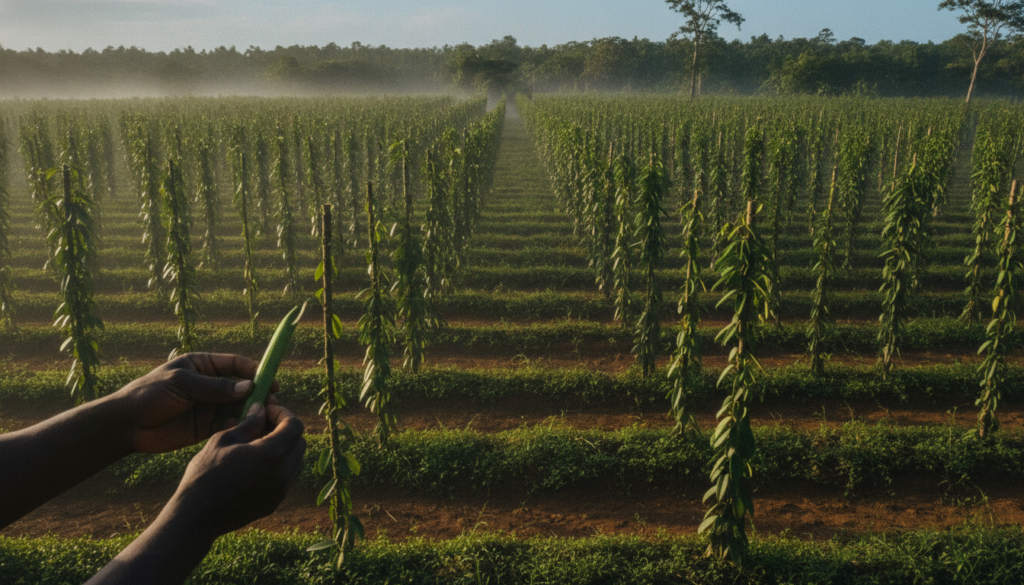
Vanilla is among the most adulterated spices in the world: synthetic flavourings sold as natural, pods of uncertain origin relabelled “Bourbon”, powders cut with other substances. A demanding buyer — individual or professional — has good reason to want to verify what they are buying before trusting a stated origin. This guide details the recognised physical signs of a quality pod, then explains why these signs alone are never enough to prove an origin.
A vanilla pod carries no physical mark indicating its country of origin. Nothing, to the naked eye, formally distinguishes a Bourbon vanilla from Madagascar from a vanilla of another origin prepared to resemble it. The term “Bourbon” itself designates a preparation method (harvesting at maturity, scalding, sweating, slow drying, curing) historically associated with Madagascar, Réunion Island and the Comoros — not a legal guarantee of origin on its own. It is this grey area that explains why the question deserves to be asked seriously, rather than relying solely on a label.
These criteria are widely recognised across the industry and help assess how well a pod has been prepared — but, as we will see, not its actual geographic origin.
A well-prepared pod bends and curls slightly around a finger without breaking or cracking. A dry, brittle pod has aged poorly or been badly stored.
The skin should be dark brown to black, with a slight sheen without excess. A pod that is too matte or greyish has probably lost some of its moisture and aroma.
A quality pod releases an immediate, rich and complex fragrance as soon as the pack is opened, a sign of successful curing over several months. A weak, flat or distinctly chemical smell should raise a flag.
Fine white crystals visible on the surface of the pod are a positive sign — naturally crystallised vanillin on the surface — not to be confused with mould, which is recognisable by its fuzzy appearance and unpleasant smell.
Quality professional-grade pods typically show a moisture content of around 30 to 35%. A pod that is too dry has lost aromatic yield; a pod that is too moist does not keep well.
These five criteria tell you about a pod’s preparation quality, not its actual origin. A well-prepared vanilla from a different origin than the one stated will pass exactly the same visual and olfactory tests. This is precisely where the difference lies between a vanilla whose origin is claimed and a vanilla whose origin is demonstrated.
A genuine origin is proven by official documents tied to a specific batch — not by a generic mention on packaging.
Under the Generalised System of Preferences (GSP Form A), the exporting country’s authorities certify that goods were wholly produced within its territory, within the meaning of European customs rules. This is an official document, issued batch by batch, not a commercial claim.
Issued by the plant protection authority of the country of origin (in Madagascar, the Directorate of Plant Protection), it certifies that a batch has been inspected and found free of harmful organisms before shipment.
An identified batch (for example a reference such as “Batch VNL0825”) makes it possible to link a specific pod to its harvest date, its packaging, and the certificates relating to it. This is what turns a stated origin into a verifiable one.
At Vanilha Noire, every batch put up for sale is tied to this kind of documentation — phytosanitary certificate and GSP Form A certificate of origin — available on request for any professional use. This is a practice any demanding buyer is entitled to ask for, whichever seller they are dealing with.
The price of a vanilla pod does not depend on a single factor, which explains sometimes significant differences between two products presented in a similar way.
| Factor | Effect on price |
|---|---|
| Grading (Gourmet vs. extraction quality) | Whole pods selected for aromatic intensity (Gourmet Black Unsplit type) cost more than pods intended for industrial extraction |
| Pod length and integrity | Long, whole, unsplit pods are rarer than fragments |
| Documented traceability | An individually certified and tracked batch involves a control cost that untraced bulk purchases do not |
| Volume purchased | The price per gram mechanically decreases as quantity increases (from retail to wholesale) |
| Harvest year and weather conditions | A weaker harvest in a given year directly influences market prices |
An abnormally low price on a vanilla presented as Gourmet-grade “Bourbon from Madagascar” should, conversely, raise questions rather than reassure.
Once the vanilla is received, the quality found at purchase only holds up if storage follows a few simple rules: air the pods in the open for at least an hour after opening a vacuum pack, before use; then store them at room temperature (around 25 °C), away from moisture, direct light and open air, ideally in their resealed packaging.
No: these are natural vanillin crystals, a sign of a well-cured pod. To be distinguished from mould, recognisable by its fuzzy appearance and unpleasant smell — in that case, the pod should be discarded.
The term “Bourbon” historically designates a preparation method associated with Madagascar, Réunion Island and the Comoros. Only official origin documentation (notably a GSP Form A certificate) can verify the actual country of production, independently of the term used on the packaging.
A serious seller should be able to provide, on request, the certificate of origin and the phytosanitary certificate tied to the batch number shown on the product.
Most often because of unsuitable storage (prolonged open air, humidity, direct light) rather than a defect in the pod itself — see the storage section above.
To go further, discover our supply chain and our selection of Bourbon vanilla from Madagascar.
Discover our selection of Bourbon vanilla pods from Madagascar, traceable batch by batch.